Direct Taxes

Finance Bill, 2026 – An overview – A way forward to “Viksit Bharat 2047”

Dr. K. Shivaram, Senior Advocate &

Shashi Bekal, Advocate


Introduction.

The Finance Bill, 2026, assumes special significance in India’s evolving fiscal and economic landscape. Coming at a time when India is positioning itself towards the ambitious national goal of “Viksit Bharat 2047”, marking 100 years of independence. The Bill is not merely an annual exercise of tax amendments, but a step towards long-term structural reforms. Thus, a holistic overview becomes necessary to understand the impact of these proposals and the way forward towards a robust tax ecosystem by 2047. In this article, we will be discussing only a few important provisions of the direct tax proposals.

The Finance Bill, 2026, seeks to balance multiple objectives:

  • Simplification of tax provisions
  • Reduction of litigation
  • Strengthening of the compliance framework
  • Boosting investor confidence
  • Aligning tax administration with digital governance.

Some of the conceptual measures that need to be addressed are:

  1. Allocation of funds to the Judiciary.

Almost all sectors have allocated more funds, whereas the Union Budget 2026-27 has allocated Rs.4509 crores for the Ministry of Law and Justice, representing a reduction from the 2025-26 revised estimate of Rs. 5,189 crores, in spite of the pendency of litigation before various courts increasing year after year. Judiciary gets only 0.08% allocation. One of the reasons for the delay in disposal of cases are lack of infrastructure in the lower judiciary and not appointing the judicial officers within a reasonable time. The ITAT Mumbai members’ library has not functional for more than three years. It seems that due to a lack of funds, the library could not be renovated.

The need of the Hour is that the Judiciary also requires sufficient allocation of funds so that it can also contribute to achieving “Vikshit Bharat 2047”. We must acknowledge and appreciate that we have made considerable progress in reducing tax litigations before the Income Tax Appellate Tribunal. The matters are taken up for hearing within three months of the filing of an appeal before the Income Tax Appellate Tribunal. Whereas there are more than five lakhs of appeals pending before the Commissioner of Income-tax (Appeals.) Some of the appeals have been pending for more than seven years. Honourable High Court in Kulwinder Paul Singh v. CBDT (2025) 475 ITR 371 (P& H)(HC), observed that inordinate delay in disposing of the appeal by the Commissioner (Appeals) would defeat the objective of the provision. If the appeal was not disposed of within this period, the reasons for such delay must be explicitly recorded in the orders, so as to reflect whether the delay was attributable to the assessee or the Department, and efforts should be made to decide the appeals within a period of two years. The order copy was sent to the Union of India and the Central Board of Direct Taxes for necessary action. Unless the department adopts some drastic measures, the pendency cannot be reduced. In the Bombay High Court, appeals admitted in the year 2004 are pending for final disposal (More than 21 years).

From 1st April 2026, the Income -Tax Act, 2025, will be implemented. When the appeals under the new Income Tax Act, 2025, are taken up, it is desired that all pending appeals before the various High Courts may be decided at the earliest. Few suggestions for consideration are discussed in this article.

  1. Reducing litigation before various High Courts.

2.1. Publication of issues pending before on direct taxes before various High Courts and the Apex Court on direct taxes.

When an Appeal or Writ Petition is filed before various High Courts, the Revenue is always either the Petitioner or Respondent. As soon as appeals are filed, the Central Board of Direct Taxes (CBDT) can get the information from the respective Commissioners in respect of the issues pending before various High Courts, and these can be compiled and published on the website of the CBDT under the legal corner. This will help both the taxpayers and the tax administration. When an issue came before the Hon’ble Bombay High Court, the Hon’ble Bombay High Court directed the Revenue to publish the information on its website. Though an assurance was given to the Hon’ble Bombay High Court by filing an affidavit stating that the website would be functional from 15-6-2016, this has not been complied with. Reference can be made to CIT v. TCL India Holding Pvt. Ltd. (Bom.)(HC); (ITA No. 2287 of 2013, dated May 06, 2016) www.itatonline.org. The Income Tax Appellate Tribunal has developed a system wherein the Hon’ble President of the Income Tax Appellate Tribunal gets the information from all 63 Benches across the country about how many appeals are filed in respective Benches and how many have been disposed of. The list is prepared every month for the appeals filed and the disposal of appeals by the respective Members of the ITAT. We suggest that such a system may be adopted by the CBDT to know the pendency of appeals across the country before various High Courts and the Hon’ble Supreme Court, and the issues involved. The list can be published on the website of the CBDT, which will help the Revenue as well as the Assessees.


2.2.  Appeals to High Court: Acceptance of orders of High Courts.

In the earlier days, whenever the Department would accept a decision of a particular High Court on the interpretation of law, the Central Board of Direct Taxes used to issue a circular stating that the judgment had been accepted. This practice seems to have been discontinued now. If this process is adopted and instructions /circulars are published, litigation will be reduced considerably and shall prove invaluable for the ease of doing business in India by bringing certainty to tax laws. The Hon’ble Bombay High Court in the case of CIT v. TCL Ltd. (2016) 241 Taxman 138 (Bom.)(HC) has passed a detailed order asking the Chief Commissioner of Income tax to host details of the matters admitted before the Bombay High Court, matters accepted by the Revenue, etc., online. If the order of the Bombay High Court is implemented, it will surely be a positive step in reducing litigation.

The CBDT vide Circular No 1 of 2011 dated April 06, 2011 (2011) 333 ITR (St) 1, Instruction No 4 of 2011 (2011) 198 Taxman 14 (St) and Instruction No 7 of 2011 (2011) 199 Taxman 26 (St) which provided guidelines to the Department for filing Appeals/SLP’s clearly records that there were several instances where Appeals were filed by the Department even though Questions of Law were not involved. This also adds to the arrears of litigation.

It has been observed that when the quantum of addition is large, though a question of fact is involved, the Revenue files an appeal invariably to avoid any query on audit in future.

  1. Accountability.

Under the New Income-Tax Act 2025, which will take effect from April 01, 2026, there is no provision for accountability on the part of the tax administration.

Dr Raja J. Chelliah, in his report [(1992) 197 ITR 177 (St) (257) Para 5.9], “The Assessing Officers should be made accountable for their actions. If the percentage of demands not upheld by the Tribunals is higher than a reasonable figure, say 50 per cent, the officer should be given a blank mark and reprimanded. On the other hand, an Assessing Officer should be protected and defended if he has obeyed instructions of the Board and followed case laws even though an audit might raise concerns about his actions”.

We suggest that Accountability provisions may be incorporated by way of CBDT circulars or notifications. In the case of Prashant Chandra v. Harish Gidwani, Dy CIT [2024] 165 taxmann.com 471 (All)(HC), in a contempt application under section 12 of the Contempt of Court Act, 1971, which was filed alleging wilful and deliberate disobedience of the judgment and order dt 31st March, 2015 passed by a Division Bench in Writ petition No. 9525 (MB) of 2013, the Allahabad High court held that disobedience of a Court’s order strikes at the very root of the rule of law upon which the judicial system rests. The rule of law is the foundation of a democratic society. The judiciary is the guardian of the rule of law. The Officer was held liable to pay a fine of Rs. 25,000 along with simple imprisonment for a period of one week, and was awarded to the contemnor.

In the case of Bloomberg Data Services (India) (P) Ltd. v. DCIT (2025) 302 Taxman 454 (Bom)(HC), where there was a delay in issuing the refunds, the court held that this was due to the laxity of the Department. The Court held that a refund of the tax amount, if any, ought to be immediately granted to the assessee. Delayed payment of refunds burdens the public exchequer due to interest that needs to be paid on the same. The Court also observed that Rules would be required to be framed and Accountability would be required to be fixed. In the last two years, on the basis of reported Judgements/Orders, one will find that there are large number of Special Leave petitions (SLP) that are dismissed only on account of delay in filing of SLP by the Revenue Authorities without a proper explanation of the reasons for delay. (Refer, Radha Madhav Investments (P.) Ltd. v. DCIT [2025] 302 Taxman 358 (SC) (Delay of 752 days, PCIT v. Joginder Singh Chatha [2025] 302 Taxman 5 (SC). (Delay of 233 days). One can give a list of a large number of cases that were dismissed only because the delay in taking up appropriate legal remedies was not properly explained. One will observe in a large number of matters that a tax credit was not given due to a mismatch. In spite of the remainders, no action is taken by the Assessing Officers.

The Hon’ble Bombay High Court in Vibhsvari Bharat Bhatt v. ITO (WP No. (L.) No. 3032 of 2026 dated February 09, 2026 (Bom)(HC) www.itatonline.org has made strong observation as under “We caution the authorities, that in the future, whether they like it or not, the orders of the jurisdictional High Court have to be followed. If in the future we find that orders of this court are not followed by the Income tax Authorities, we will not hesitate to haul up the concerned officers for contempt, amongst other things”

This is mainly because there is no accountability provision in the tax law. It is a need of the hour that the Accountability provision be introduced.

  1. Tribunals Reforms Act, 2021.

In the case of Madras Bar Association v. UOI (SC) 2025 SCC OnLine SC 2498, the Honourable Supreme Court has struck down the Tribunal Reform Act, 2021. The Court strongly criticised the Government for persistently disregarding its repeated directions on tribunal appointments, observing that such non-compliance has caused massive vacancies, rendering several tribunals “on the verge of closure” and leading to a complete denial of access to justice. It directed the Government to ensure timely appointments and strictly adhere to the constitutional parameters earlier laid down. Honourable Court directed the Union of India a period of four months from the date of this judgment to establish a National Tribunals Commission. The commission so constituted must adhere to the principles articulated by this Court, particularly concerning independence from executive control, professional expertise, transparent processes, and oversight mechanisms that reinforce public confidence in the system. We hope the Government will honour the judgement of the Apex court and, when the National Tribunals Commission is constituted, will hear the stakeholders.

  1. Specific amendments in the Finance Bill, 2026.

5.2.  Rationalising Penalty & Prosecution. (Sections, 379, 411, 439, 470, 471, 474 , 475, (Clauses, 71, 79, 84, 91, 92 , 94, 95)

In the present scheme of taxation first, an assessment order is passed, and based on the findings/ additions made in it and subject to the status of appellate proceedings, a penalty is initiated in the assessment order by the Assessing Officer. Subsequently, separate penalty proceedings are initiated by giving a show cause notice, which results in the passing of a separate penalty order after giving due opportunity to the assessee. This triggers yet another chain of appellate proceedings.

It is proposed that where a penalty is proposed to be levied under section 439 of the New Act, in those cases, a common order of assessment and penalty will be passed.

The present system of Assessment order and penalty order is well accepted in the Indian Income-tax Act, 1922, as well as the Income-tax Act, 1961. When the appellate authority deletes the quantum addition or set a aside the assessment, the penalty proceedings will not survive. The whole exercise by the Assessing Officer to pass a penalty order may become futile. It is suggested that the present system of levying the penalty when the quantum is settled by the Appellate Authorities may be continued, and the proposed provision may be dropped.

Further, expanding the scope of immunity on levy of penalty or prosecution, it is proposed to amend the existing Section 440 of the New Act that allows an assessee to seek immunity from the imposition of penalty under Section 439 of the New Act and from initiation of prosecution proceedings under Sections 478/479 of the New Act relating to underreporting of income, if specified conditions are met. According to it, any taxpayer on whose case an assessment or reassessment order has been made under the relevant provisions, and has paid the tax and interest due within the demand period, and has not filed an appeal against that order, may apply.

As per the current provisions, granting of such immunity is not available for cases where penalty proceedings have been initiated for under-reporting in consequence of misreporting of income.

The scope of granting of immunity under section 440 of the Act is proposed to be expanded to cover all such cases where penalty proceedings are initiated for under-reporting in consequence of misreporting of income, provided the taxpayer pays an additional income-tax as specified in lieu of such penalty.

The proposed expansion of the scope of section 440 of the Act to cover all cases where penalty proceedings are initiated either for under-reporting income or for under-reporting income in consequence of misreporting. However, the taxpayer would be required to pay an additional income-tax in lieu of a penalty as prescribed for being eligible for granting an immunity for misreporting of income.

This is a welcome amendment and would definitely aid in reducing litigation.

Furthermore, the conversion of the levy of penalty to a fee in cases of delay in filing the audit report by amending section 454 of the Act is a welcome amendment. However, the nature of the fee is automatic in nature and without any ‘reasonable cause’ clause. This does not allow genuine cases to have their delay condoned.

Sections 475 to 478 & 494 of the New Act (Clauses 95 to 98 & 105) are being amended to partially decriminalise certain offences, fully decriminalise certain offences and change the nature and period of punishment prescribed therein. The maximum punishment for any offence has been brought down from its current 7 years to 2 years, and the punishment for subsequent offences has been brought down from its current 7 years to 3 years.

The earlier grading of Rs. 25 lakhs has been changed to the new grading. Now, the punishment for offences in case the amount of tax involved exceeds 50 lakhs rupees, shall be a maximum of 2 years; punishment in case the amount of tax involved exceeds 10 lakhs rupees but does not exceed 50 lakhs rupees shall be maximum 6 months; and punishment in case amount of tax involved does not exceeds 10 lakhs rupees shall be only fine.

The rationale of the grading is to rationalise the extent of punishment so as to persuade compliance. While prosecution leading to imprisonment as a punishment has been kept for offences involving deliberate disobedience and high tax evasion, the punishment has been monetary where the default is of lower value. The new grading system is progressive and inclusive in nature, keeping in view global practice as well as the spirit of Jan Viswas. The nature of punishment has been changed from rigorous punishment to simple imprisonment in sections 475 to 478 & 494 of the New Act. In case of certain offences, Imposition of a fine is introduced in lieu of or in addition to imprisonment. This is a welcome amendment.

The legal principle that the benefit of decriminalisation or reduction in punishment should be applied to pending cases is known as the doctrine of beneficial interpretation or the principle of the most lenient criminal law (LPMB).

In India, while Article 20(1) of the Constitution prohibits ex post facto laws (making a past act a crime or increasing punishment), it does not prohibit the retroactive application of a reduction in punishment or decriminalisation.

The Hon’ble Supreme Court in the case of Rattan Lal v. State of Punjab, AIR 1965 SC 444 (SC) held that if a later law reduces the punishment for an offence or decriminalises it, the reduced penalty can be applied retrospectively to benefit the accused.

Section 278E of the income -tax Act , 1961 deals with the presumption as to culpable mental state. As per the section, the burden is on the accused to prove that he had no such mental state with respect to the act charged as an offence in the prosecution. The need of the hour is that Section 490 of the New Act may be suitably amended, and the burden may be shifted to the revenue to prove culpable mental state. This will help to the large number of assesees the prosecution was launched only for technical offences.

Prosecution matters have been pending for disposal for more than 20 years before the Magistrate Courts. There has to be a research study on how to reduce the pendency of matters and the way forward. We hope the Government will constitute an expert committee to deliberate and to suggest appropriate measures which will benefit the assesses as well as the Revenue.

5.3.  Changes in undisclosed income provisions. (S. 195, 439, 443) [Clauses 46, 84, 86]

Section 195 of the New Act corresponds to section 115BBE of the Old Act, which prescribed the rate of tax for addition on account of unexplained cash credits, unexplained investments, unexplained assets, unexplained investment and amount borrowed or repaid through negotiable instrument, hundi, etc.

It can be inferred that the rate of 60 per cent was prescribed with a view to penalising those taxpayers who did not avail the Income Declaration Scheme, 2016, which prescribed a rate of 45 per cent.

The rate of tax in the Income -tax Act, 1961 was increased to 60 per cent vide Taxation Laws (Second Amendment) Act, 2016. The said rate of 60 per cent was levied irrespective of voluntary disclosure or determined by the Assessing Officer.

The Hon’ble Supreme Court in the case of Vivek Narayan Sharma v. Union of India (2023 3 SCC 1) (4:1 majority) upheld the 2016 demonetisation scheme, declaring it reasonable, proportionate, and not unlawful. While this focused on the policy, it legitimised actions taken to curb black money.

It is now proposed to amend section 195 of the New Act to reduce the rate of tax to 30 per cent.

It is also clarified that there will be no levy of a penalty in case of voluntary disclosure, and in cases of income determined by the Assessing Officer, the provisions of section 439 of the New Act, i.e., under-reporting of income and misreporting of income, will follow.

A taxpayer can settle a dispute even after the determination of income by the Assessing Officer by offering additional income-tax amounting to 120 per cent of the amount of tax payable on under-reported income.

It is advisable to clarify that in the event of voluntary disclosure, the return will not protect the Assessee from any proceedings under other statutes, viz. Conservation of Foreign Exchange and Prevention of Smuggling Activities Act, 1974, Unlawful Activities (Prevention) Act, 1967, the Narcotic Drugs and Psychotropic Substances Act, 1985, the Prohibition of Benami Property Transactions Act, 1988, the Prevention of Corruption Act, 1988, the Prevention of Money Laundering Act, 2002, etc.

Further, on analysis of the proposed rate of tax, it can be seen that as per the current rate, the total effective outgo is 84 per cent [60 per cent tax + 25 per cent surcharge + 4 per cent education cess + 10 per cent penalty]

However, as per the proposed amendment, the total effective outgo in case of voluntary disclosure will be 39 per cent [30 per cent tax + 25 per cent surcharge + 4 per cent education cess] and in cases determined by the Assessing Officer, will be 99 per cent [30 per cent tax + 25 per cent surcharge + 4 per cent education cess + 200 per cent penalty]

The intention of the legislature appears to be forgiving and allowing taxpayers to come clean with a much lower effective outgo. At the same time, if the income is determined by the Assessing Officer, then the effective outgo rise is higher than what it presently is.

5.4.  Taxation of buyback of shares. [S.2(40), 69] [Clauses 27 and 34]

As per the existing provisions, consideration received by a shareholder on buy-back of shares by a company is treated as dividend income and taxed accordingly, while the cost of acquisition of the shares extinguished on buy-back is recognised separately as a capital loss.

The said capital loss is only useful if there are capital gains in the same year or subsequent years.

It is proposed to once again treat buy back of shares as a capital gain. However, a distinction has been made among shareholders. For a non-promoter shareholder, the normal rates of long-term capital gain and short-term capital gains will prevail. Where the promoter shareholder is a domestic company, the rate of tax is 22 percent and for promoters other than a domestic company, the rate of tax is 30 per cent.

The proposal to tax the real income is welcomed. However, the same rate of tax for both long-term capital gains and short-term capital gains seems to be unreasonable, and the discrimination between promoters appears to be arbitrary.

For the purpose of buy-back, the term “promoters” is defined under section 34 of the New Act. In cases of a listed entity, on a recognised stock exchange in India, ‘promoter’ shall have the same meaning as assigned to it in regulation 2(k) of the Securities and Exchange Board of India (Buy-Back of Securities) Regulations, 2018 made under the Securities and Exchange Board of India Act, 1992 and in any other case, “promoter” as defined in section 2(69) of the Companies Act, 2013 or a person who holds, directly or indirectly, more than 10% of the shareholding in the company.

The usage of the term “indirectly” is not defined in the Act and has always invited litigation.

Further, whether shares acquired prior to 2017 would be grandfathered and whether the shareholders would get the benefit of the Treaty if the genuineness of the investment is doubted is a matter of uncertainty in light of the recent decision of the Hon’ble Supreme Court in the case of AAR v. Tiger Global International II Holdings [2026] 182 taxmann.com 375 (SC).

5.5.  ESI & PF Contribution.[S.29(1)(e)] [Clause 31]

Section 29(1)(e) of the Income-tax Act, 2025 allows for the deduction of any amount of contribution received by the employer (being the assessee) from the employee, if such amount is credited to the employee’s account within the due date.

The controversy on the interpretation of what the due date is persisted in the old Act as well. Several High Courts took a view that the due date is the due date of filing of the return under the scheme of Income Tax.

The Hon’ble Supreme Court in the case of Checkmate Services (P.) Ltd. v. CIT [2022] 448 ITR 518 (SC) held that For assessment years prior to 2021-22, non obstante clause under section 43B of the Old Act could not apply in case of amounts which were held in trust as was case of employee’s contribution which were deducted from their income and was held in trust by assessee-employer as per section 2(24)(x) of the Income-tax Act, 1961 , thus, said clause would not absolve assessee-employer from its liability to deposit employee’s contribution on or before due date as per the welfare statute as a condition for deduction.

The Hon’ble Supreme Court in the case of Woodland (Aero Club) (P.) Ltd. v. ACIT SLP 1532 of 2026 dated January 27, 2026 (SC) has issued notice on examining the deduction under section 43B of the Act on the Old Act.

It has been proposed that any amount of contribution received from employee by the employer (being the assessee), towards any approved provident fund, superannuation fund or any fund set up under ESI Act shall be allowed as deduction if such amount is credited to the relevant fund, on or before the due date of filing of return of income under section 263(1) of the New Act which is applicable for the employer.(Clause 57)

This is a welcome amendment. It is advisable to extend this amendment to the Income tax Act, 1961 as it would further reduce pending litigations.

5.6.  Foreign Assets of Small Taxpayers – Disclosure Scheme 2026. [Section 49 & 50 of the Black Money (Undisclosed Foreign Income and Assets) and Imposition Act, 2015 (Black Money Act).

The Scheme provides a one-time opportunity to eligible taxpayers to disclose specified foreign income and assets either not taxed or not reported in the return of income, on payment of tax or fee, with immunity from further tax, penalty and prosecution under the Black Money (Undisclosed Foreign Income and Assets) and Imposition of Tax Act, 2015.

For “undisclosed assets located outside India” or “undisclosed foreign income”, the Scheme applies where the aggregate value does not exceed ` 1 Crore as on 31st March 2026. For foreign assets acquired from disclosed income or during status as a non-resident, the value of the asset must not exceed ` 5 Crore as on 31st March 2026.

The declarant is required to pay tax at the rate of 30 per cent of the value of the undisclosed foreign asset as on 31 March 2026 or of the undisclosed foreign income, as the case may be, together with an additional amount equal to 100 per cent of such tax. The total amount payable will be 60% of the value of the asset or foreign income, as the case may be. Where the foreign asset was acquired during non-resident status or from income already offered to tax in India but was not disclosed in the relevant return schedules, a flat fee of ` 1 Lakh is payable, subject to the value threshold. If the asset is the same, then only one time fee would be chargeable and would be applicable for the first year of non-disclosure. Thereafter, it would be deemed that the asset remains disclosed. However, if there are assets that were acquired in multiple years, then the fee would be chargeable for the corresponding first years when the asset was undisclosed.

5.7.  Stay of Demand.

Taxpayers can now obtain a stay of demand on an order under appeal by paying 10 per cent of the disputed amount, down from the previous requirement of 20 per cent as per the CBDT Office Memorandum [F. No. 404/72/93-ITCC] dated July 31, 2017.

This is a welcome amendment as the rate of deposit will reduce the cash flow crunch in MSMEs and small businesses. However, a Circular or

5.8.  Retrospective amendments.[Income-tax Act, 1961, S.144C, 147A, 148, 148A, 153B, 292BA, Income-tax Act, 2025, S. 279, 522] (Clauses 7, 8, 9, 10, 26, 62, 106)

There have been 4 retrospective amendments which are clarificatory in nature, addressing the much-litigated issues viz. (i) Document Identification number (DIN), (ii) Faceless Assessing Officer v. Jurisdictional Assessing Officer, (iii) Time-limit for completion of assessment under section 144C of the Old Act and (iv) The manner of computation of sixty days for passing the order by the Transfer Pricing Officer.

These are highly litigated issues with a huge number of cases pending at various stages of litigation. However, there was no Supreme Court decision on any of these issues.

This amendment is clarificatory in nature, and as per the interpretation of statutes, clarificatory amendments are retrospective in nature. Even otherwise, the legislature has the power to introduce retrospective amendments as it is not violative of any Fundamental right guaranteed in Part III of the Constitution of India, nor does the provision infringe or is ultra vires any other provision of the Constitution.


  1. Role of Tax Practitioners.

As noted by the Chairman of the CBDT, as of February 2026 more than 88 per cent of assessees have opted for the new tax regime. As per paper report only 1% of tax returns are selected for scrutiny 99% accepted on trust. With the advent of the faceless assessment system, the importance of professional assistance has increased significantly. In such a regime, it is only those professionals who are well-versed in law and procedure who can effectively represent taxpayers and make meaningful submissions before the tax authorities.

In practice, we have observed that a large number of co-operative societies in Mumbai either fail to claim the deduction available under section 80P of the Act, or where such deductions are claimed, they are often disallowed at the processing stage. Unfortunately, in many cases, no timely remedial action is taken. As a result, appeals are filed belatedly, and in several matters, the delay extends for years. This is largely due to a lack of awareness of the applicable legal provisions and procedural requirements.

Tax practitioners, equipped with the necessary expertise, play a crucial role in guiding assessees to secure the deductions and reliefs legitimately available under the law and in ensuring that appropriate remedies are pursued within prescribed timelines.

Equally important is the contribution of voluntary professional organisations such as the AIFTP, BCAS, and the Chamber of Tax Consultants. These bodies regularly organise study circles, training programmes, and professional development courses to better equip their members. They also provide constructive suggestions from time to time for improving tax legislation and administration.

To achieve the national vision of “Viksit Bharat 2047”, these organisations can join hands to undertake focused research on key issues affecting taxpayers and the tax system. For instance, two important subjects deserving immediate attention could be:

  • Measures to reduce tax litigation, and
  • Rationalisation of prosecution proceedings that have remained pending for decades.

There are several other practical subjects of day-to-day importance that could also be studied. Such initiatives would be a valuable service to the nation, and it is hoped that the Government will consider these suggestions in an objective and constructive manner.

  1. Conclusion.

The AIFTP has always played an active role in advocating for fair tax administration. It may be recalled that the Federation had filed a Public Interest Litigation before the Hon’ble Supreme Court against the steep increase in fees for filing appeals before the Income Tax Appellate Tribunal. At that time, the then Chief Justice, Hon’ble Justice Mr. S.H. Kapadia, requested withdrawal of the petition on the ground that when trade associations were not opposing the increase, it was difficult to appreciate how Tax Practitioners alone were affected.

This episode highlights the need for collective support from trade and professional bodies alike in matters concerning better law, better administration, and access to justice. It is sincerely hoped that trade associations will actively support such causes in the larger interest of taxpayers and the nation.

[Source : AIFTP Journal February 2026 Volume 28 No. 11]
  1. Introduction.

The centenary of The Chamber of Tax Consultants, Mumbai, one of the oldest and most respected professional bodies in the country, is not merely a celebration of longevity but a tribute to a century-long commitment to integrity, excellence, and service to the tax profession. As tax practice undergoes rapid transformation driven by technology, data analytics, and faceless regimes, the subject of “Ethics, Professional Responsibility in Modern Tax Practice and Conventions – Path Forward” assumes renewed significance. Ethical conduct is not an impediment to effective tax practice; rather, it is its very foundation.

The great jurist Mr. M. C. Chagla, the first Indian Chief Justice of the Bombay High Court, stated:

“The legal profession is a great calling, and it is a learned and liberal profession. Remember always that it is a profession; it is not a trade or business. The distinction between the two is deep and fundamental. In business, your sole object is to make money. You owe no duty or obligation to anyone except to yourself. You determine the means to achieve your aim and there are no standards to limit or restrict your actions. In the profession, making of money is merely incidental. You have traditions to which you have to be true. Like an artist, there has to be a passionate desire to attain perfection. Service to society and justice to fellow men has to be the dominant motive underlying your work.”

Taking inspiration from the words of Justice Mr. M. C. Chagla, this article attempts to examine the ethical obligations of tax professionals in modern times, judicial recognition of professional responsibility, conventions, and the path forward for preserving public trust in the tax profession.

  1. Ethics: The Soul of the Tax Profession.

The practice of taxation is intrinsically linked with public finance, constitutional governance, and citizens’ rights and obligations. Every tax professional operates at the intersection of the State’s power to levy taxes and the taxpayer’s right to be treated fairly. Article 265 of the Constitution of India reads:

“No tax shall be levied or collected except by authority of law.”

The taxpayer has an obligation to pay tax that is rightfully due to the State—neither more nor less.

Professional ethics are not ornamental but fundamental, forming the backbone of any learned profession. The legitimacy of a profession depends not only on technical competence but also on moral accountability.

For tax professionals, ethics manifests in:

  • Honesty in disclosure
  • Independence in advice
  • Confidentiality of client information
  • Avoidance of conflicts of interest
  • Respect for law and institutions
  1. Advocates and Chartered Accountants: A Common Ethical Standard.

Advocates and Chartered Accountants, though governed by different statutes and professional bodies, share a common ethical standard. However, for tax practitioners, there is no single statutory body that lays down professional ethics. Many leading tax professional bodies have adopted a Code of Conduct for their members; hence, tax practitioners are also governed by the respective codes adopted by their associations.

The Hon’ble Supreme Court in Mahipal Singh Rana v. State of Uttar Pradesh (2016) 8 SCC 335 observed:

“No judicial system in a democratic society can work satisfactorily unless it is supported by a Bar that enjoys the unqualified trust and confidence of the people, that shares the aspirations, hopes, and ideals of the people, and whose members are monetarily accessible and affordable to the people.”

The Court further observed:

“The legal profession is a solemn and serious occupation. It is a noble calling and all those who belong to it are its honourable members. Although entry to the profession can be had by acquiring merely the qualification of technical competence, the honour as a professional has to be maintained by its members by their exemplary conduct both in and outside the court.”

In P. D. Khandekar v. Bar Council of Maharashtra (AIR 1984 SC 110), the Court observed:

“The Preamble to Chapter II, Part VI of the Rules lays down that an advocate shall at all times comport himself in a manner befitting his status as an officer of the Court, a privileged member of the community, and a gentleman. Rule 36 provides that an advocate shall not solicit work or advertise, either directly or indirectly, whether by circulars, advertisements, touts, or personal communications. It is a well-recognised rule of etiquette in the legal profession that no attempt should be made to advertise oneself or solicit work, directly or indirectly.”

In tax practice, this translates into a duty:

  • Not to mislead authorities
  • Not to encourage abusive tax positions
  • Not to fabricate or suppress material facts
  1. Duty to the Client and Duty to the Law: A Delicate Balance.

A tax professional undoubtedly owes a duty of loyalty and competence to the client. However, this duty is not absolute and cannot override the duty to the law. True professionalism lies in having the courage to say “no” when a proposed course of action is unethical or unlawful.

  1. Candour and Fairness before Authorities.

With the advent of faceless assessments and digital interfaces, written submissions have replaced oral persuasion. This places a greater ethical burden on professionals to ensure:

  • Accuracy of facts
  • Fair presentation of law
  • Avoidance of misleading citations or selective quotations

The credibility of the profession depends on whether its members are perceived as assistants to justice rather than obstructions to administration.

  1. Confidentiality and Data Ethics in the Digital Age.

Modern tax practice involves handling vast volumes of sensitive personal and financial data. Ethical responsibility today extends beyond legal confidentiality to data stewardship.

Unauthorised sharing of client information, lax cybersecurity practices, or misuse of data for collateral purposes can cause irreparable harm. Professional ethics require tax practitioners to adopt:

  • Robust data protection measures
  • Clear internal protocols
  • Awareness of privacy principles

Confidentiality is not merely a contractual obligation; it is a fiduciary duty.

  1. Mentorship, Education, and Ethical Continuity.

Ethics is not inherited automatically; it must be taught, practised, and transmitted. Senior members of the profession carry a special responsibility to mentor younger professionals not only in law and procedure but also in values and conduct.

Institutions like The Chamber of Tax Consultants have historically played a vital role in:

  • Promoting ethical discourse
  • Encouraging scholarly debate
  • Providing platforms for principled advocacy

At a time when commercial pressures are high, institutional guidance becomes even more vital.

  1. True Professional: Thoughts of Dr. Nani A. Palkhivala and Shri P. N. Shah.

Members of the Journal Committee of the Bombay Chartered Accountants’ Society interviewed Padma Vibhushan Dr. Nani A. Palkhivala, Senior Advocate, published in BCAJ (September 1988, pages 791–816). At page 799, he stated:


“A ‘true professional’ is a person with courage, integrity, and humility. If a Chartered Accountant or a lawyer has intellectual integrity, he will never give an opinion merely to suit the client. Every professional must have that ideal before him when advising clients.”

Shri P. N. Shah, Chartered Accountant and former President of the Institute of Chartered Accountants of India and BCAS, in his article “Role of Professionals in Tax Practice” (Income Tax Review, Aug–Sept 1996, p. 117), laid down seven governing principles:

(i)     Integrity – A professional should be straightforward, honest, and sincere.

(ii)    Objectivity – A professional must remain fair and unbiased.

(iii)    Independence – A professional must both be and appear independent.

(iv)   Confidentiality – Client information must not be disclosed without authority or legal requirement.

(v)    Technical Standards – Duties must be discharged in accordance with applicable standards.

(vi)   Professional Competence – Only work that can be competently handled should be undertaken.

(vii)   Ethical Behaviour – Conduct must uphold the reputation of the profession.

A professional who adopts these principles in daily practice can achieve enduring success and inner satisfaction from service to society and the profession.

9.     Conventions and Duties of Members of the Bar.

Over the years, the Bar has evolved well-recognised conventions that embody dignity, discipline, decorum, and professional tradition. The Mumbai Tax Bar is widely acknowledged as one of the finest tax Bars in the country.

At a farewell function held in Mumbai on 16 November 2019, Hon’ble Mr. Justice Akil Kureshi, then Chief Justice of the Tripura High Court, observed:

“You are an outstanding Bar, having excellent seniors, very competent middle-level advocates, and talented juniors.”

Hon’ble Mr. Justice Akil  Kureshi further stated:

“Some of the finest tax counsel are from the office of Mr. Soli Dastur, Senior Advocate. Mr. Soli Dastur had about 20 to 21 juniors, and today we have at least 5 or 6 quality all-India arguing counsels from just one Chamber. We need more Soli Dasturs in this place.”

Mr. V. H. Patil, Advocate, has mentored and trained  over  21 juniors  in his chambers. Mr. Y. P. Trivedi, Senior Advocate, has mentored and trained over   10 juniors from his chambers. The Chamber of Tax Constantans owes its prestigious standing to the leadership of icons such as Shri V.H .Patil Advocate , Shri .Y.P. Trivedi Senior Advocate  and Shri .S.E. Dastur Senior Advocate .  It is a matter of great distinction for us to belong to an institution shaped by such exemplary stalwarts of the profession.

Many leading members of the Mumbai Tax Bar were fortunate to have trained in renowned chambers of senior advocates/Advocates  who served as role models in professional excellence and ethical conduct. I myself had the privilege of being associated with the chamber of Shri V. H. Patil, Advocate, who was widely respected for his integrity, scholarship, and ethical standards. A senior advocate’s chamber is not merely a place for learning advocacy skills; it is where a young lawyer imbibes the conventions, values, and discipline of the profession.

Over time, however, the traditional chamber culture has been gradually diminishing. Today, a large number of young advocates and Chartered Accountants appear before the Income Tax Appellate Tribunal (ITAT). While many possess excellent command over law and facts, several have not had the opportunity to closely observe and internalise the long-standing conventions of professional conduct before the Tribunal.

We had the privilege of witnessing stalwarts such as Shri R. J. Kolah, Shri N. A. Palkhivala, Shri S. P. Mehta, and several others argue before the High Court and the Tribunal. Any tax professional aspiring to excellence must read the special issue of the All India Federation Journal (AIFTPJ – August 2003) titled “Federation Salutes to the Three Stalwarts of the Tax Bar”, dedicated to Shri R. J. Kolah, Shri N. A. Palkhivala, and Shri S. P. Mehta.

Hon’ble former Chief Justice of India, Hon’ble Mr. Justice S. H. Kapadia, then a Judge of the Bombay High Court, in his message dated 9 June 2003 titled “My Tribute to the Stalwarts of the Tax Bar”, wrote:

“In the field of Income Tax Law, out of a few luminaries, there were three legends; i.e. late Shri R. J. Kolha, late Shri S. P. Mehta and late Shri Nani Palkhivala, who devoted their professional practice to the field of Direct Tax laws. I deem it a great privilege to have been requested by the All India Federation of Tax Practitioners to forward them my tribute to the above stalwarts in the form of a message for their publication.

All three stalwarts led the Tax Bar in intellect, clarity and integrity. They have provided a valuable legacy in the form of their juniors who today have emulated these three stalwarts in the above virtues and who, in turn, today are leaders of the Tax Bar.

I was lucky to have seen the three stalwarts in action when they were not so young and yet, after hearing them for a few moments, I came out of the court with the following words which flashed across my mind:

‘The spirit knows no youth or age, no fatigue or death.’

These are the qualities and virtues which should inspire our young professional lawyers and I am happy to state that, even today, in the Tax Bar practising in the High Court, there are young professional lawyers who are following in the footsteps of these three legends.”

I appeal to young professionals to read the aforesaid publication, which is also available on the website www.aiftponline.org, to understand the enduring values, ethics, and professional standards upheld by these three stalwarts of the Tax Bar.

With a view to guiding young practitioners appearing before the ITAT, the following conventions deserve careful attention:

  1. Follow the Dress regulations for representatives of the parties as prescribed under Rule 17A of Income -tax (Appellate Tribunal ) Rules, 1963.
  2. No appearance should be made without written authorisation, which should be filed in advance.
  3. Address the Bench as “Your Honours” or “Sir”, and not as “Lordship”, “My Lord”, or “Your Worship”.
  4. Adjournment applications should be filed at least three days in advance, with a copy served on the Departmental Representative.
  1. Even for adjournments, authorised representatives must appear in the prescribed dress.
  1. While seeking an adjournment, be familiar with the basic facts, as the Hon’ble Members often inquire about the issue involved.

7.      Where there is delay in filing an appeal, an application for condonation of delay                  supported by an affidavit must be filed along with the appeal.

8.      Paper books should be filed at least a week before with proof of  service of a copy of          the same on the other side    as prescribed under Rule 18 of  Income -tax (Appellate                    Tribunal ) Rules , 1963.

  1. Before arguing the matter, verify whether the contents of memorandum of appeal as per the Rule 8 of Income -tax (Appellate Tribunal) Rules, 1963.
  1. Maintain courtesy towards Senior Advocates during mentioning.
  1. No reading of newspapers inside the courtroom.
  1. No conversations during court proceedings.
  1. No drinking water while seated during proceedings.
  1. Authorised representative must enter the court with prescribed dress as per the Rules of the ITAT. No coats should be worn during proceedings when the hearing is in progress.
  2. No usage of mobile phones in the courtroom.

16     Always face the Bench while addressing the Tribunal.

  1. The appellant has the right to begin and reply. [CIT v. Khemchand Ramdas (1933) 1 ITR 309 (Bom) (HC)].
  1. Factual corrections may be made only with the permission of the Court.

19     Judgments must be verified before being cited. [Raghubhai Surabhai Bharwad v. Satishkumar Ranchhoddas Patel (2003) Cri LJ 3984 (Guj.) (HC) (para 22)].

  1. Change of counsel should not be made without consent. [Balaram Tiwari v. Regional Transport Authority, Varanasi Region (2000) All LJ 2407 (All.) (HC) (para 7)].
  1. An accepted vakalatnama binds appearance despite unpaid fees. [Mehbub Ali Khan, In re: AIR 1958 AP 116 / 1958 Cri LJ 155 (FB) (AP) (HC) (para 5)].
  1. Laughter in court is improper; at most, a gentle smile is permissible.
  1. Even in virtual hearings, dress regulations and courtroom decorum must be strictly maintained.
  1. Always keep the relevant assessment year’s Income-tax Act and Rules readily available for reference.
  1. When the last matter of the day is being heard and no other representative is present, do not leave the courtroom before the Bench rises.

10. Path Forward.

As the Chamber of Tax Consultants enters its second century, the profession stands at a defining moment. Laws may evolve and technology may transform practice, but ethical values must remain immutable.

Professional success without integrity is fleeting; a reputation founded on ethics endures across generations.

As tax practitioners, we must remain mindful of Article 51A(j) of the Constitution of India- Fundamental duties ,  which  reads as under “to strive towards excellence in all spheres of individual  and collective activity so that the nation constantly rises to higher of endeavour and achievement”.

May the next century of the Chamber of Tax Consultants continue to be guided by learning tempered with humility, advocacy anchored in ethics, and excellence rooted in responsibility.

I am grateful to Mr. Jayant Gokhale, President, and Mr. Vipul Chokshi, Chairman, Centenary Committee, for the opportunity to share my thoughts on this important subject.

My best wishes to the Chamber on this memorable centenary occasion.

Jai Hind.

31-12-2025

[Source : Centenary Year Souvenir – The Chamber of Tax Consultants Page No. 85 to 90 (30th & 31st January 2026)]

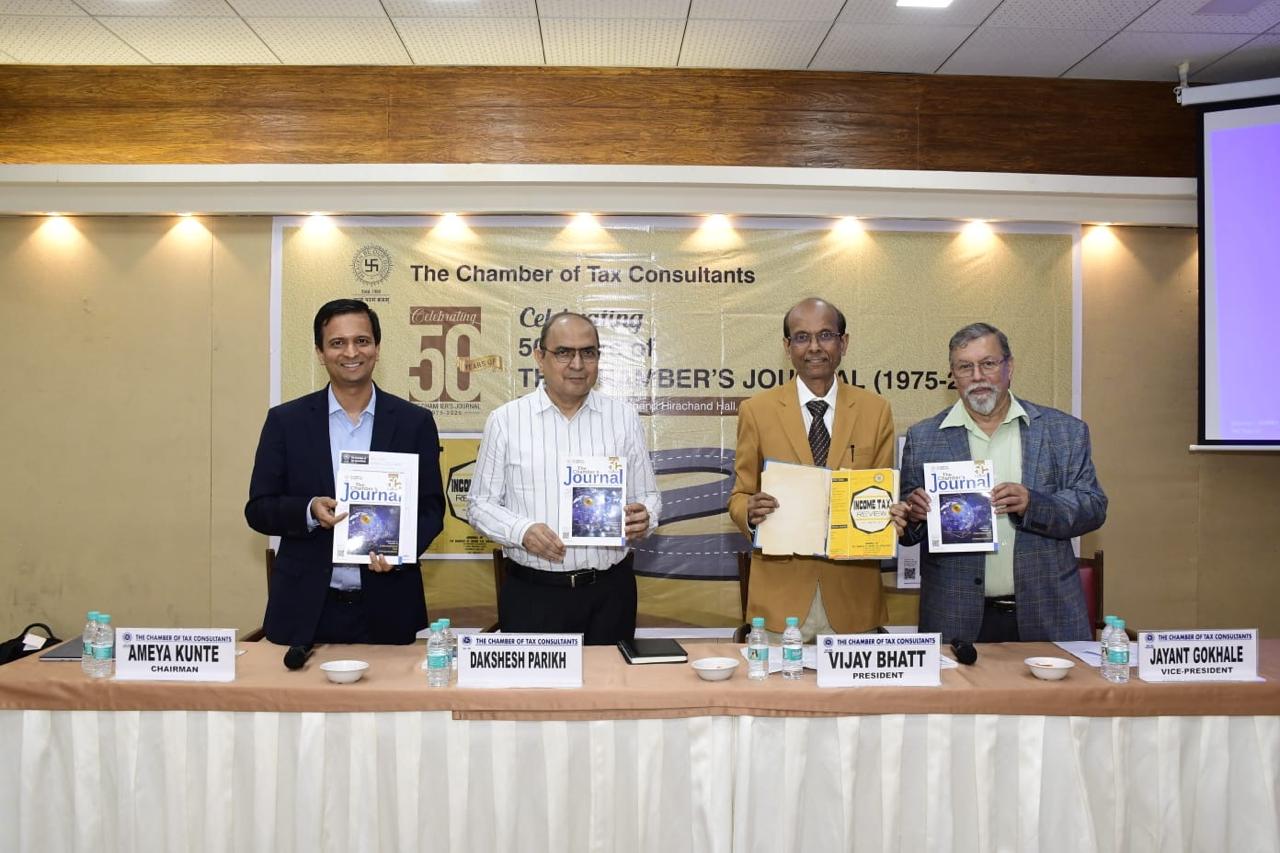
50 years of Journal of the Chamber of Tax Consultants  (Chamber’s Journal)

Dr. K. Shivaram, Senior Advocate.

Tribute and Vision – Celebrating 50 years of Chamber’s Journal and Charting the path ahead.  (1975 -2025 )

1. Editorial: A summary of the speech delivered on the occasion of the 50th anniversary celebration of the Chamber’s Journal, held on 25th April 2025 at IMC Mumbai.

I had the privilege of serving the Chamber’s Journal for 9 years. I sincerely express my gratitude to the dedicated professionals and staff of the Chamber, whose efforts have contributed to the Journal’s remarkable 50-year journey. I also extend heartfelt thanks to the many professionals whose valuable contributions have helped shape the Journal into one of the most prestigious publications in our country.

  1. Acknowledgement of gratitude.

I extend my sincere gratitude to Mr. Hitesh Shah, Manager of the Chamber, for his constant support and dedication. Before him, we were fortunate to have the guidance of the late Mr. Vasnadani, whose contributions were deeply valued. A special note of appreciation goes to Mr. Rajesh Bhagat and his team, who have been associated with the Chamber’s Journal for over three decades, playing a vital role in its continued excellence.

I extend my heartfelt gratitude to all eleven editors of the Chamber’s Journal, whose contributions have been instrumental in shaping its legacy. They truly deserve special acknowledgement for their dedication and service:

  • Late Shri Arvind Thakkar
  • Late Shri B.C. Joshi, Advocate
  • CA Chetan Karia
  • Late Shri H.K. Sajnani, Advocate
  • K. Shivaram, Senior Advocate
  • Shri K. Gopal, Advocate
  • Shri K.K. Ramani, Advocate
  • Shri Keshav Bhujle, Advocate
  • Late Shri V.H. Patil, Advocate
  • CA Vipul Chokshi
  • Shri Vipul Joshi, Advocate

Their collective efforts have greatly contributed to the Journal’s growth and reputation as a leading professional publication.

I sincerely appreciate the invaluable contributions of the Journal Committee members during my tenure as Editor. Their dedication and behind-the-scenes efforts were vital to the Journal’s success. I am especially grateful to Mr. Mitesh Kotecha, Mr. Pradip Kapasi, Mr. Ninad Karpe, Mr. Sanjay Parikh, Mr. Chetan Karia, Mr. Paresh P. Shah, Mr. Maur Desai, Mr. Atul Maturia, Mr. Pravin Veera, Mr. Kishor Vanjara, Mr. Anish Thacker, Mr. K. Gopal, Mr. Pravin Mahru, Mr. M. Subramanian, Mr. Yatin Vyavaharkar, Mr. Jayant Ghokale, and many others for their unwavering support.

  1. Unique feature of the Journal–Special issues.

In July/August 1987, we introduced the concept of the “Special Issue” for the first time, with our inaugural edition focusing on Prosecution under the Income-tax Act, 1961. The most recent Special Issue, published in April 2025, is titled Special Features on Trends in International Tax Interpretation.” As of April 2025, the Chamber has published a total of 352 Special Issues – each serving as a valuable reference for tax professionals. For the benefit of readers, Advocate Neelam Jadav has compiled a comprehensive list of all Special Issues, which is available for ready reference on www.itatonline.org.

https://itatonline.org/digest/articles/the-chambers-journal-reference-to-special-issues-from-1987-to-april-2025/

Some of the landmark Special Issues are:

  • Model Deeds – the 35th Special Issue, released by Shri S.E. Dastur, Senior Advocate and Past President.
  • Vision 2000 – Tax Laws and Tax Administration – the 45th Special Issue, featuring views of high taxpayers, published under the Presidentship of Mr. Keshav Bhujle.
  • 50 Landmark Judgments – the 51st Special Issue, released by the then Chief Justice of the Bombay High Court, Hon’ble Justice Mr. M.B. Shah, at Hotel West End. This issue was dedicated to 50 years of India’s independence and was published under the presidency of Mr. Subash Shetty.
  1. Tax judges

In the earlier days, we used to send copies of the Chamber’s Journal to the Judges of the Tax Bench of the Bombay High Court. Notably, former Chief Justice of India, Hon’ble Justice Shri S.H. Kapadia, was a regular reader of our Journal. This reflects the wide reach and credibility the Journal has earned over the years.

5. Editorial

Let me share with the readers that one of our editorials was cited in a Public Interest Litigation (PIL) filed before the Supreme Court of India, highlighting the influence and relevance of our content. Similarly, when the Voluntary Disclosure Scheme was challenged before the Bombay High Court, the Revenue Department relied on our editorial to support the scheme. These instances underscore the credibility and impact of the Chamber’s Journal in shaping legal and policy discourse.

My senior, Shri V.H. Patil, always wrote editorials straight from the heart. One particularly memorable piece was his editorial on Shri S.P. Mehta, published in the year 1990, in Volume 15 of the Chamber’s Journal

“Shri S.P. Mehta was a great source of inspiration to all to try to become a noble professional. Today, the Tax Bar is more idealistic compared to bars of other branches of law; this is because the tax bar was fortunate to have great idealistic leaders like Shri S.P. Mehta“   

6.   Thought for consideration – Conventions, code of ethics and accountability of the tax profession

Many young professionals today are not sufficiently aware of the conventions, code of ethics, and accountability that form the foundation of the tax profession. When we joined the field, especially in High Court practice, the Chamber culture strongly emphasised values and professional conduct, guided by senior mentors. Sadly, this culture is now fading.

In courtrooms, we often see a lack of decorum—such as reading newspapers, turning one’s back to the bench, wearing coats, or casual chatting during proceedings—mainly due to a lack of guidance.

To address this, the Chamber could consider a Special Issue on Conventions, Code of Ethics, and Accountability in the Tax Profession as part of its centenary year celebrations, along with a lecture by a retired Supreme Court or High Court judge to reinforce these essential principles

7.   Value addition.

When we began our practice, the only magazine reporting Tribunal judgments was titled “Taxes and Planning.” It served as a key resource for tax professionals at the time. As we move forward, it is important to reflect on how we can continue to add value for our readers and address the evolving needs of the tax profession.

  1. Coordination with a sister organisation.

Mr. Narayan Varma, Chartered Accountant and Past President of the Chamber, was a great visionary in the tax profession. He often reminded us that we must work in complement with sister organisations, not in competition. In that spirit, it may be worth considering the idea of holding at least one joint meeting of the Journal Committee with sister organisations. Such collaboration could greatly benefit the professional community and foster a more unified approach to knowledge-sharing.

9. Special issues will be continued.

Regardless of advancements in digitalisation or artificial intelligence, the Special Issues of the Chamber’s Journal will continue to be valued and appreciated for generations to come.

My best wishes to the Journal Committee and its future leadership. I am grateful to President Mr. Vijay Bhat, Editor Mr. Anish Thacker, and Chairman Mr. Ameya Kunte for the opportunity to share my thoughts on the Journal’s 50th anniversary.

The Journal Committee works tirelessly throughout the year and requires a truly dedicated team. I extend my sincere appreciation and best wishes to all its committed members.

Good luck to the President and his team.

All the best.

Thank you once again.

Dr. K. Shivaram, Senior Advocate.

Learned Senior Advocate has made various suggestions for the consideration of the  Hon’ble Chairman and members of the Select Committee of Lok Sabha to examine the Income-tax Bill, 2025, Cell

(SCITB CELL). He has divided his suggestions into three parts, i.e.

(1) The provisions which are not considered in the Income-Tax Bill,2025.

(2) Few specific conceptual suggestions, and;

(3) Certain administrative measures which may be desired for better implementation of the New Income-tax Bill, 2025, and to achieve the desired objective of simplification of tax law and tax administration.

Some  of the important suggestions are, Accountability in tax administration, suggestions for reducing pendency before various High Courts and the Supreme Court,  increasing the scope of appeals to Income tax appellate Tribunal, Appointment of Members of the Income Tax Appellate TribunalArbitration in tax matters, Independent grievance Committee – Trust Deficit,  Nodal Officer, Tax Service and not collection, Major Amendments in tax laws should be made only once in five years. Independent Committee to suggest amendments to tax laws.

Editorial Board.


May 30, 2025


To,

Hon’ble Chairman,

Select Committee of Lok Sabha

to examine the Income-tax Bill, 2025,Cell

(SCITB CELL )

Parliament House Annexe

New Delhi. 110001.

Ref:   Examination of the ‘Income -Tax Bill , 2025’ by the Select Committee of the Lok Sabha.

 Sub: Suggestions for the consideration of the Hon’ble Chairman and Members of the committee.

Hon’ble Sir,

We highly appreciate the Introduction of the Income-tax -Bill 2025. The sincere efforts made by the committee to draft the Income-tax Bill, 2025, deserve to be acknowledged. We also acknowledge the sincere efforts of the members of the Select Committee of the Lok Sabha in interacting with various stakeholders across the country. Sir, we are sure that when the new Bill will be introduced in the Parliament, it will be the version taking into consideration of all the suggestions given by the various stakeholders. We are sure the New Income -Tax may be able to achieve the objectives of our Hon’ble Prime Minster Shri Narendra Modi, when we, as a Nation celebrate our centenary in the year 2047.

Sir, we have a few thoughts for the consideration of the Hon’ble members of the committee, which are divided into three parts,

(1)     The provisions which are not considered in the Income-Tax Bill, 2025.

(2)     Few specific conceptual suggestions, and

(3)     Certain administrative measures which may be desired for better implementation of the New Income-tax Bill, 2025, and to achieve the desired objective of simplification of tax law and tax administration.

  1. The provisions which are not considered in the Income –Tax Bill, 2025

1.1   Accountability.

Hon’ble Sir, under the Income-Tax Bill 2025, there is no provision for accountability on the part of the tax administration. Dr. Raja J. Chelliah,

in his report [(1992) 197 ITR 177 (St) (257) Para 5.9], “The Assessing Officers should be made accountable for their actions. If the percentage of demands not upheld by the Tribunals is higher than a reasonable figure, say 50 per cent, the officer should be given a blank mark and reprimanded. On the other hand, an Assessing Officer should be protected and defended if he has obeyed instructions of the Board and followed case laws even though an audit might raise concerns about his actions”.

We suggest that Accountability provisions may be incorporated in the New Income-tax Bill, 2025. In Prashant Chandra v. Harish Gidwani, Dy CIT [2024] 165 taxmann.com 471 (All)(HC), in an contempt application under section 12 of the Contempt of Court Act, 1971 , which was filed alleging wilful and deliberate disobedience of the judgement and order dt. 31st March, 2015 passed by a Division Bench in Writ petition No. 9525 (MB) of 2013, the Allahabad High court held that disobedience of a Court’s order strikes at the very root of the rule of law upon which the judicial system rests. The rule of law is the foundation of a democratic society. The judiciary is the guardian of the rule of law. The Officer was held liable to pay a fine of Rs. 25,000 along with simple imprisonment for a period of one week, and was awarded to the contemnor. In Bloomberg Data Services (India) (P) Ltd. v. DCIT (2025) 302 Taxman 454 (Bom)(HC), where there was a delay in issuing the refunds, the court held that this was due to the laxity of the Department. The Court held that a refund of the tax amount, if any, ought to be immediately granted to the assessee. Delayed payment of refunds burdens the public exchequer due to interest that needs to be paid on the same. The Court also observed that Rules would be required to be framed and Accountability would be required to be fixed. In the last two years, on the basis of reported Judgements/Orders one will find there are large number of Special Leave petitions (SLP) are dismissed only on account of delay in filing of SLP by the Revenue Authorities without a proper explanation of the reasons for delay. (Refer, Radha Madhav Investments (P.) Ltd. v. Dy. CIT [2025] 302 Taxman 358 (SC) (Delay of 752 days, PCIT v. Joginder Singh Chatha [2025] 302 Taxman 5 (SC). (Delay of 233 days). One can give a list of a large number of cases which are dismissed only on account of the delay in taking up appropriate legal remedies was not properly explained. This is mainly because there is no accountability provision in the tax law. It is desirable that some accountability provision may be suggested in the proposed Bill ,so that the tax collected may be utilised for better purposes.

  • Suggestions for reducing pendency before various High Courts and the Supreme Court.

1.2.1. Publication of issues pending before on direct taxes before various High Courts and the Apex Court.

Hon’ble Sir, when an Appeal or Writ Petition is filed before various High Courts, the Revenue is always either the Petitioner or Respondent. As soon as appeals are filed, the Central Board of Direct Taxes (CBDT) can get the information from the respective Commissioners inrespect of the issues pending before various High Courts and these can be compiled and published on the website of the CBDT under the legal corner. This will help both the taxpayers as well as the tax administration. When an issue came before the Hon’ble Bombay High Court, the Hon’ble Bombay High Court directed the Revenue to publish the information on their website. Though an assurance was given to the Hon’ble Bombay High Court, by filing an affidavit stating that the website would be functional from 15-6-2016, this has not been complied with. Reference can be made to CIT v. TCL India Holding Pvt. Ltd. (Bom.)(HC);(ITA No. 2287 of 2013, dt. 06.05.2016) www.itatonline.org. Hon’ble Sir, the Income Tax Appellate Tribunal has developed a system wherein the Hon’ble President of the Income Tax Appellate Tribunal gets the information from all 63 Benches across the country about how many appeals are filed in respective Benches and how many have been disposed. The list is prepared every month for the appeals filed and the disposal of appeals by the respective Members of the ITAT. Hon’ble Sir, we suggest that such a system may be adopted by the CBDT to know the pendency of appeals across the country before various High Courts and the Hon’ble Supreme Court and the issues involved. The list can be published on the website of the CBDT, which will help the Revenue as well as the Assessees.

 1.2.2.  Clauses, 365 to 366 .[Section.260A]: Appeals to High Court -Acceptance of orders of High Courts.

In the earlier days, whenever the Department would accept a decision of a particular High Court on the interpretation of law, the Central Board of Direct Taxes used to issue a circular stating that the judgement had been accepted. This practice seems to have been discontinued now. If this process is adopted and instructions /circulars are published, litigation will be reduced considerably and shall prove invaluable for the ease of doing business in India by bringing certainty to tax laws. The Hon’ble Bombay High Court in CIT v. TCL Ltd. (2016) 241 Taxman 138 (Bom.)(HC) has passed a detailed order asking the Chief Commissioner of Income tax to host details of the matters admitted before the Bombay High Court, matters accepted by the Revenue, etc. online. If the order of the Bombay High Court is implemented, it will surely reduce by a positive step in reducing litigation.

The CBDT vide Circular No 1 of 2011 dated April 06, 2011 (2011) 333 ITR (St) 1, Instruction No 4 of 2011 (2011) 198 Taxman 14 (St) and Instruction No 7 of 2011 (2011) 199 Taxman 26 (St) which provided guidelines to the Department for filing Appeals/SLP’s clearly records that there were several instances where Appeals were filed by the Department even though Questions of Law were not involved. This also adds to the arrears of litigation.

It has been observed that when the quantum of addition is large, though a question of fact is involved, the Revenue files an appeal invariably to avoid any query on audit in future. If the reference is rejected by the Tribunal on facts, the Revenue may not take the matter further. The High Court is the Third Appellate authority under the Income Tax law and is to entertain only substantial questions of law.

The Hon’ble Bombay High Court is presently listing final hearing Appeals which were admitted in 2003, i.e. even after more than 22 years, the appeals that truly require adjudication on points of law languish and are not decided as the High Court is burdened with needless Appeals on disputed facts.

1.2 3.  Availing the services of retired judges on a ad-hoc basis:

Article 224A of the Constitution of India enables the appointment of retired judges at sittings of High Courts as ad-hoc judges. As the pendency in the various high Courts is increasing, the services of specialised ad-hoc judges may be availed for effective disposal of cases and efficient dispensation of justice. This step shall help in reducing the pendency of matters before various High Courts. This could be an effective measures to reduce the pendency of matters before various High Courts.

1.3. Sections 245B to 245M: Settlement Commission – One-time settlement of disputes – No provision in the Income -Tax Bill, 2025.

The settlement commission was introduced in the year 1975 with the very laudable object. However, one of the reasons for its lack of outright success was that the Government has appointed only retired Officers to the commission. Regardless, it is desirable that the provision may be re-introduced. It will help the revenue as well as the taxpayers to settle tax disputes within a reasonable time.

1.4.   Section 257: Statement of case to the Supreme Court in certain cases – No provision in the Income -Tax Bill, 2025.

Though the Income–tax is an all-India statute, the Appellate Tribunal

sitting in a particular State is bound by the decision of the respective High Court of the particular State. It is possible that High Courts takes contrary views on the same important issue which affects a large number of assesses . In such a case, the decision of the Jurisdictional High Court will be binding bringing uncertainty in tax law. This is because two different benches of the Tribunal may have to take different stands based on the Judgements of the Jurisdictional High Courts. To avoid all these controversies, the Tribunal may be given power to refer the matter to the Supreme Court either of its own, or on an application made by the assessee or the department. If this process is followed, there will be certainty in tax law, which will also help to reduce the pendency of cases before various High Courts, and finality may be attained on some of the important issues within a reasonable time.

 1.5.    Arbitration in tax matters (Lok Adalat)

The Committee may consider the proposal of constituting a committee consisting of representatives from the legal and accountancy profession and from the tax department of the rank of Principal Chief Commissioner of Income-tax for arbitration in tax matters. The assessee may refer the matter to such committee within 30 days of receipt of the order from the Assessing Officer, and the committee should pass an order within six months from the receipt of the application. The order passed by such a committee may be made binding on both parties. To begin with the matters like technical defaults, refunds, etc., may be referred for resolution. The concept of Lok Adalat may be introduced for tax matters. The Government may consider the services of retired members of the Appellate Tribunal. The proposal will benefit the taxpayers as well as the tax department.

  1. Specific suggestions on the New Income -Tax Bill, 2025

2.1.   Clause, 315. [Section 171] :Partition – Assessment after partition of a Hindu Undivided family .

When a partition of HUF takes place, the assessee has to inform the Assessing Officer to recognise the partition. There is no procedure prescribed to inform the Assessing Officer. Now the assessment is made in a faceless manner. The issue has become more complicated. There are instances where the though the application is made, no order is passed by the Assessing Officer. As there is no time limit prescribed under the Act, it is desired that a specific provision may be made in the Act itself. When an application is made by an assessee to recognise the partition, if no order is passed by the Assessing Officer within six months, it may be deemed to be accepted. It is also desirable to have specific rules for making an application for partial and total partition of HUFs.

2.2.    Clause, 390 .[Section 199] – Credit for tax deducted – Cash method  of accounting or project competition method.

When an assessee follows a cash system of accounting, there is invariably a mismatch of 26AS statement with the claim in the return of the assessee. This is because the year of deduction and the year of the income being offered for taxation may be different. For most of the assessee, the adjustments are made due to a mismatch. It is suggested that the section may state that when an assessee follows a cash system of accounting, the credit may be granted to the assessee in the year in which the income is offered for taxation, which will reduce the unintended litigation.


2.3.  Clauses, 356 to 360 .[ Sections 246A, 248] Appealable orders before Commissioner (Appeals), appeal by a person denying liability to deduct tax in certain cases.

2.3.1. All orders of the Assessing Officer may be appealable.

To avoid litigation on the issue of appealable orders, every order passed by the Income tax authority, i.e. Assessing Officer/tax recovery Officer, etc., which has the effect of adversely affecting an assessee in any manner may be made appealable before the Commissioner (Appeals). Under the present Income -Tax Act,1961 , there are a number of decisions which state that when an assessee denies his liability, it is an appealable order. Central Provinces Manganese Ore Co. vs. CIT (1986) 160 ITR 961 (SC). To avoid such a situation, an appropriate amendment may be made in the Income-Tax Bill, 2025, which will save substantial time for Revenue as well as the judiciary.

2.3.2. Remand report.

In a number of matters, before the Commissioner of Income- tax (Appeals) the assessee files an additional evidence. In such a situation, the Commissioner of Income- tax (Appeals) has to call for a remand report. It has been observed that there is no time limit prescribed for forwarding the remand report so prepared to the Commissioner of Income- tax (Appeals) . This can lead to delays in the appeal process. It is desired that a time limit for furnishing a remand report be prescribed in the Act.

2.3.3. No time limit is prescribed for either for hearing of the appeal or after hearing passing of the order.

There is no outer time limit prescribed for passing an order by the Commissioner of Income -tax (Appeals) after the hearing concludes. As per the Appellate Tribunal Rules 1963, Rule 34(5) the Income tax Appellate Tribunal has to pronounce the order within 60 days from the date on which the hearing is concluded, but where it is not practicable so to do on the ground of exceptional and extraordinary circumstances of the case the Bench shall fix a future day for pronouncement of the order and such date shall not ordinarily be a beyond a further period of 30 days and due notice shall be given to the parties concerned. It is desired that such a provision may be introduced in the Income-Tax Bill, 2025 for passing the orders by the Commissioner of Income -tax (Appeals) or any other first appellate Authority .

2.3.4. Orientation Course for Commissioner of Income -Tax(Appeals).

One will find that many of the Commissioners (Appeals) dismiss Appeals without deciding the issues involved on their merits. Various High Courts have held that the Commissioner (Appeals) have no power to merely dismiss the appeal; they have to decide issues on the merits. (CIT(Central) v. Premkumar Arjundas Luthra (HUF) (2016) 240 Taxman 133 (Bom)(HC). When an appeal is filed before the Income-tax Appellate Tribunal, the Tribunal has no option but to set aside the matter back to the file of the Commissioner (Appeals). This causes a wastage of both, resources and time. The Hon’ble Supreme Court has also held that the Commissioner (Appeals) has to deal with each and every ground raised in appeal and has to pass a speaking order. (M.P. Industries vs. UOI, AIR 1966 SC 671,  Siemens Engg. Vs. UOI, AIR 1976 SC 1785.) In many cases, the orders are not ‘speaking orders’. Therefore, when the matters are taken up before the Tribunal, the Tribunal has to set aside the matter.

Suggestions.

  1. It is suggested that before posting Officers as Commissioners (Appeals), they may be requested to work as Departmental Representatives before the Income Tax Appellate Tribunal for at least six months.
  2. The Commissioner (Appeals) may be trained by a Sitting Judge or retired Judge of the High Court, on the principle of natural justice, binding precedent, etc. from time to time. 
  1. Clause 362 .[Section . 253] : Appeal to Appellate Tribunal.

An appeal can be filed before the Income Tax Appellate Tribunal within 60 days of receipt of an appealable order. In case of delay, the Tribunal can condone delay. In case the delay is not condoned and the appeal is dismissed . In V. K. Sreenivasan v. CIT (2013) 213 Taxman 17 (Mag)(Ker.)(HC), the Kerela High Court held that an appeal under section 260A is not maintainable against an order passed by the Tribunal declining condonation of delay. The court also observed that, even though a statutory appeal under section 260A is not maintainable against the orders of the Tribunal declining to condone the delay, the aggrieved person can probably invoke the jurisdiction of the High Court under Articles 226 and 227 of the Constitution and probably, in appropriate cases, the High Court can grant relief. To avoid litigation, an provision may be made in the Act making all orders of the Appellate Tribunal are appealable.

  1. Clause , 363 .[ Section . 254(2)] – Rectification of mistake.

In an order rejecting the rectification of a mistake, there is no statutory appeal provided. An Appeal against an order rejecting the application made under section 254(2) of the Act is not maintainable. This has been held in Chem Amit v. ACIT (2005) 272 ITR 397 (Bom.)(HC), Safari Mercantile Pvt. Ltd. v. ITAT (2016) 386 ITR 4 (Bom.) (HC), CIT v. Singhal Industries (2017) 395 ITR 264 (Raj) (HC), Madhav Marbles & Granites v. ITAT (2012) 65 DTR 217 / 246 CTR 243 / 2012 Tax LR 465 (Raj.)(HC). However, in L. Shobanraj v Dy.CIT (2003) 260 ITR 155 (Karn) (HC) DCIT v. H.V. Shantharam (2003) 260 ITR 156 (Kar)(HC), the Hon’ble Karnataka High Court has taken a view that an appeal under section 260A lies against an order under section 254(2) of the Act on a substantial question of law. It is desired that the specific provision may be introduced stating that all orders of the Income Tax Appellate Tribunal is an appealable order before the High Court .

  1. Clause, 363 [ Section . 254(2A)] : – Stay application.

When a stay application is rejected by the Tribunal, the only remedy is to file a writ petition before the Jurisdictional High Court. It may be desirable to provide a statutory appeal before the High Court against the rejection of the stay application by the Tribunal. Refer, Pepsi Foods Pvt. Ltd. v. ACIT (2015) 376 ITR 87 / 119 DTR 373 / 277 CTR 470 / 232 Taxman 78 (Delhi)(HC)

  1. Clause, 365 .[Section . 260A] : Appeal to High Court.

An appeal to the High Court can be filed only on a substantial question of law. As per section 260B, the appeal before the High Court is to be heard by a bench of a strength not less than two judges. When a writ petition is filed against the order of an Assessing Officer or any issue on constitutional validity in Mumbai, Delhi, or Gujarat it is always heard by two judges, whereas in some of the High Courts like, Madras, Kerala etc. it is heard by a single judge and thereafter in appeal by a division Bench. To bring uniformity, it may be desirable to make an amendment in the Act stating that any writ petition against the Income -Tax Bill, 2025, should be heard by a division bench of two judges.

  1.  Clauses , 361 to 364 [ Sections 252 to 255] : Appeal to Appellate Tribunal, qualification -Appeals to Appellate Tribunal, Increasing the scope of appeals to Appellate Tribunal and reducing the Writ to High Courts.

  7.1.  Appeal to Income tax Appellate Tribunal.

There are a number of orders of the Commissioners of Income-tax against which no appeal is provided. The only remedy available to the assessee is to file a Writ Petition before the High Court. E.g. orders under section 264, 273A, waiver of interest charged under sections 234A, 234B, and 234C, orders under section 179, denial of approval u/s. 10(23C) and other approvals by the Chief Commissioner, denial of condonation of delay in filing various forms, etc. A simple amendment in the Income-tax Act may be made stating that all orders of the Chief Commissioner or, Commissioner are appealable to the Tribunal. This would save substantial time for the High Court and the taxpayers would get speedy justice from the Tribunal.

Click here to Pendency before ITAT

Click here to Pendency before CIT(A)

7.2.   Appointment of members on a tenure basis.

The Income Tax Appellate Tribunal cannot be compared with the other Tribunals. Hence, the appointment of members of the Income tax Appellate Tribunal on a tenure basis may not be made applicable to the appointment of members of the Income Tax Appellate Tribunal. As we are introducing he new Income tax Act, the old provision of appointment of the members of the Income tax Appellate Tribunal regular basis may be reintroduced . The Income tax Appellate Tribunal Bar Association Mumbai and the All India Federation of the Tax Practioners have made detailed representation to the Honourable Finance Minster and Honourable Law Minister from time to time , the said representations may be considered

Click here to representation of ITAT Bar Association 

Click here to Blog posted on April  26 , 2024 

  1. Certain administrative measures may be desired for better implementation of the New Income-tax Bill, 2025, and to achieve the desired objective of simplification of tax law and tax administration.

4.1.    Pendency of prosecution before various Courts across the Country.

Tax prosecution matters have been pending for disposal for more than 20 years across the country. The need of the hour is the quick disposal of the matters. The CBDT may have to constitute a committee of experts to find out the reason for delay in the disposal of matters and what remedial action may be desired.

 4.2.   Independent grievance Committee – Trust Deficit:

There is a trust deficit between the taxpayers and the tax administration. The Constitution of India is the supreme law of the land in our country. One of the most important provisions of the Constitution of India is Article. 265, which provides that “No tax shall be levied or collected except by authority of law”. The collection of taxes has to be within the framework of law. The CBDT Circular No. 14 (XL-35), dt. 11/04/1955 states that a duty is cast upon the Assessing Officer to assist and aid the assessee in the matter of taxation. Assessing Officers are supposed to advise the assessee and guide them, and not take advantage of any error or mistake committed by the assessee or of their ignorance. The function of the Assessing officer is to administer the statute with solicitude for the public exchequer with an inbuilt idea of fairness to taxpayers. In practice, the intention of the circular is not implemented. It is desired that there has to be an independent committee to consider the various grievances of the taxpayers, and the said committee should be able to direct the officer concerned to act upon within a specified period. The confidence of the taxpayers in tax administration will increase, and voluntary compliance will increase.

4.3.    Nodal Officer

The regime of faceless assessment and faceless appeals have helped taxpayers. There are instances where refunds of tax are received within a day of filing the return. The initiative of the Government deserves to be acknowledged. However, there are a number of issues for which taxpayers are not able to get guidance from the tax administration. Many senior citizens are not well-versed in the computer system. It is desired that the Tax department can appoint a nodal officer whom the assessee can contact and get clarification.

4.4.    Tax Service and not collection.

It is desired that the mindset of the tax administration officials may be changed to the concept of ‘tax service’ rather than ‘tax collection’. For example, if a senior citizen is not able to contact tax officials due to ill health, the tax officials may visit his/her place and try to solve the difficulties in filing of return, not getting refunds, etc. In earlier days, the Chief Commissioner of Mumbai used to have meetings with the high taxpayers and interact with them about the difficulties faced by them in the course of assessment, refunds, etc. These initiatives will help with better compliance.

4.5.    Major Amendments in tax laws should be made only once in five years.

The Finance Bill of every year should deal with the rates of taxation, and certain clarification or simplification may be made, however, major amendments should be made only once in 5 years. Mr.Palkhivala, in his article titled “ The Maddening in the stability of Income Tax Law” (Source ITAT , 1941 -1991, Golden Jubilee Souvenir ) stated that “ Simple provisions like Sections 11 to 13 ( Which deal with exemption of the income of charitable Trusts ) have suffered no less than fifty amendments).

Click here to The Maddening in the stability of Income Tax Law

Honourable sir, it is due to frequent amendments that the Income –Tax law has become more complicated. We therefore suggest that, major Amendments in tax laws should be made only once in five years. We also suggest that no retrospective amendment is desired unless to overcome the difficulties faced by the tax payers.

4.6     Independent Committee to suggest amendments to tax laws.

There may be an independent Committee constituted consisting of  representatives from the profession, tax administration, taxpayers, etc., to go into details of various suggestions received from various bodies. This should suggest amendments after examining these suggestions in detail which should be made public for debate. Only then should the amendments be introduced. If this process is followed, we are of the considered view that 90% of tax litigation will be reduced automatically. Hon’ble Sir, these suggestions are made objectively to have better tax law and tax administration for our country. I hope that they are considered as my small contribution in the noble endeavour that this Hon’ble Committee has embarked upon.

Jai Hind!

Thanking You


We are pleased to acknowledge that your honour has served this great institution of the Income Tax Appellate Tribunal (ITAT) for 23 years with extraordinary dedication, a paragon of integrity and a judicial mind of exceptional insight.

We had the fortune of appearing before your honour in a large number of matters at ITAT Mumbai. It was a great privilege to appear before your honour.


One of the great qualities of a judge your honour possesses is granting a patient hearing. Whether a junior or senior representative would appear, your honour used to hear the cases very patiently and pass the order incorporating all the submissions made by both sides.


The Tax Bar is always impressed by the great quality of your honours with the in-depth knowledge of general law, tax laws grasping of the issues involved and justice to the assesses. Your honour has authored many landmark judgements which will be remembered as precedents in the years to come. The gist of a few important landmark case laws authored by your honour is published in itatonline.org. In Evershine Recreation Private Limited v. DCIT (2023) 107 ITR 65 (SN) (Chd)(Trib) www.itatonline.org dealing with the issues on reassessment your honour has written a detailed order of 359 pages dealing with all the issues on re-assessment. Professionals are referring to the said decision as a guide to reassessment proceedings.

Honourable Sir, we would like to extend our heartfelt gratitude to your Honour for the character, integrity, courage, learning and judicial dedication with which Your Honour has served this great institution of ITAT.


Your Honour will be remembered as a role model to Honourable Members of the ITAT in the years to come and above all, a truly remarkable human being, and we had the fortune of interacting with your honour.

Your Honours’s contribution to ITAT and the legal community will remain with us for many years to come.


Honourable Sir, I, on behalf of the members of the Tax Bar, wish your honour all the best on the superannuation on 5th November 2024 and pray that the Almighty God continue to bless your honour for the rest of your life.


From


Dr. K. Shivaram,

Senior Advocate.


Dr. K. Shivaram  Senior Advocate.

Income-tax Appellate Tribunal (ITAT) – Appointment of the Honourable Members of the ITAT on a tenure basis of four years and proposed Faceless hearing before the ITAT  will destroy the fabric and independence of the institution- Tax Bar Associations across the country have to join together and make a Representation to the consideration of the Honourable Prime Minster of India to bring the status of the appointment of Honourable Members of the ITAT  as it existed before 2017.  

The Income -Tax Appellate Tribunal ( ITAT)  which was established on January 25, 1941, and has completed its 83 years of existence and is considered one of the finest institutions of our country. The ITAT is considered as the Mother Tribunal and as a role model to the establishment of other Tribunals across the country. One of the reasons for the success of the ITAT is the manner of appointment of the Hon’ble members of the ITAT.

In the year 1941 when the ITAT was established, the tenure of the Honourable Members who were appointed was for five years, and the sitting judges were also appointed as members of the ITAT. However, when the number of litigations increased, more benches were constituted, and then the legislature with effect from February 25, 1950, amended the process of the appointment of members permanently till the time of their retirement. The retirement age was initially 60 years and thereafter it was increased to 62 years and the retirement age of the Hon’ble President was 65 years. In a conference held in Mumbai in the year 2006, the then Honourable Law Minister H. R. Bharadwaj stated that he was in favor of increasing the age limit of all members to 65 years.

When the ITAT completed its Silver Jubilee, in year-1996, (25 years ) Ruby Jubilee in the year 1981, ( 40 years )  Diamond  Jubilee in the year  2001(50 years ), and Platinum Jubilee in the year 2016  (75 years ) all stakeholders including the legislatures and Judiciary appreciated the functioning of the ITAT. The then Honourable Union Law Minister  Shri H.R.Gokhale  ( Lok Sabha debates  – 18th  Session ) on the Constitution (42nd  Amendment Bill ) stated as under ;

“ I have got an example of the Income-tax Appellate Tribunal. We have judicial members, we have accountant members. The Tribunal is functioning extremely well and even those people who have gone before the Income-tax Appellate Tribunal have told me and have spoken on the public platform that the Income-tax Appellate Tribunal as it is constituted today, is the best example to show how the tribunals if properly constituted, can create confidence. I can say that the income-tax Appellate Tribunal’s decisions are rarely interfered with by the High Courts and the Supreme Court   because the quality of their work is sufficiently good as to inspire confidence .”

(Source Members conference  -29-10- 1977 )  (Fine Balance   2017, P. 431)    

A thought for debate is why suddenly changes are made in the process of appointment of the Honourable members of the ITAT   in the year 2017.?

In the year 2017, the Ministry of Finance introduced section 184 of the Act and introduced the concept of Members on a Tenure basis. The only reason given for doing so was to bring uniformity in appointing the members of the various Tribunals functioning in the country. The ITAT Bar Association Mumbai, All India Federation of Tax Practitioners, and tax professionals across the country had sent detailed representation to the Ministry of Finance and Ministry of Law urging them to drop the proposals as regards the appointment.

Despite various representations without allowing hearing to the stakeholders, the law is implemented. The members of the Tax Bar Associations across the country are of the considered opinion that if the appointment of the Members of the ITAT is continued on a tenure basis of four years and if the faceless hearing is introduced it will destroy the fabric and independence of the institution of the ITAT which was established on 25 th January 1941. The brief reasons are as under:

  1. Final fact-finding Authority

The ITAT is the final fact-finding authority under the Income-Tax Act and an appeal can be filed to the High Court only upon a substantial question of law or if the order of the Tribunal is perverse. In the High Court appeals filed in the year 2003 are still pending for final hearing despite the best efforts made by the Bombay High Court to dispose of a large number of tax matters. Tax Bench Headed by Honourable Justice Mr. K.R. Shriram in the last two years has disposed of more than 10,000 tax matters, however, due to a shortage of Judges most of the High Courts are not able to dispose of the regular Income tax appeals.  On reading the reported judgments one can realise why so many writ petitions are filed before various High courts. From the assessee’s point of view due to one wrong order of the ITAT, it will take 20 years to get it corrected by the High Court.

  1. The Income-tax Act, of 1961 refers to 106 Central Acts and various State Legislations and frequent amendments.

 The Income-tax Act, of 1961 is the only legislation of our Country that refers to 106 Central Acts and various State Legislations. If one looks at the development of Hindu Law, the Transfer of Property Act, of 1882, the Indian Trust Act, of 1882, the Negotiable Instruments Act, of 1881, the Companies Act, of 2013, the Indian Partnership Act, of 1932, the Limited Liability Partnership Act, 2008, Trade Marks Act, 1999, Copyright Act,1957, Indian Trusts Act,1882, Indian Contract Act, 1872, Sale of Goods Act 1930, etc, in addition to Constitution of India, issues under personal laws including Succession and Marriage Acts have to be also adjudicated while dealing with taxation matters. One has to consider the situation of a member appointed on a tenure basis at the age of 55, will they be able to study and decide issues arising in such complicated law? Normally it is seen that it takes nearly four to five years to understand the complicated issues of taxation. A member who has not seen the Income Tax Act till the age of 55 years,   will they able to decide the very complicated issue of taxation. 

  1. Double taxation agreements.

 India has double taxation agreements with more than 100 countries. Understanding the intricacies of international taxation and transfer pricing requires a deeper study of not only income tax law, accounting, and international taxation. At present, most of the matters relating to International Taxation are headed by the Hon’ble member who has served more than 15 years as a member of the ITAT. The quality of judgments of the ITAT on International Taxation is appreciated across the world.  Consider a situation where a person has not read the Double taxation agreements, if he is asked to decide the very complicated issue of interpretation of the Double Taxation avoidance agreement, a person who has joined at the age of 55 will find it difficult to adjudicate such a complicated issue.

  1. Revenue is litigant either as an appellant or respondent.

Before the Income Tax Appellate Tribunal, in all the appeals, the revenue is a litigant either as an appellant or respondent. Therefore, the functioning of the Income Tax Tribunal cannot be compared with other Tribunals. When a Member decides on a tax matter, if his term is to be renewed by the committee appointed by the Govt., they may lean in favour of the Revenue due to fear that if they decide against the Revenue, their term may not be renewed further. This will affect the impartial justice delivery system.

  1. Honourable Members of the Income Tax Appellate Tribunal.

The sanctioned strength of the members of the ITAT is 126 members. The ITAT has at present 115 members.  Few of the Honourable Members have been in service for more than 15 to 20 years, they can guide the newly appointed Honourable members, the convention of the ITAT, and the quality of the orders to be passed. One will find at present  59 members are appointed on a tenure basis. One is not sure how many will be reappointed. Earlier, judicial and accountant members could be appointed with 10 years of practice.  In the years 2024 and 2025, more than 12  members will retire who have been appointed regularly. It seems about  20 Honourable Members have been appointed on a tenure basis their term will be ending in the year 2025. Thereafter it may be very challenging for the Honourable President of the ITAT to manage the functioning of the ITAT. In some of the stations, only members having less than 5 years’ experience may have to decide all important issues that may be affecting all stakeholders across the country.  If one bench decides on a question law it is binding on all benches across the country. Imagine a situation where a bench in a remote part of our country decides a question of law that will bind across the country till it is reversed by the High Court. At present the members are posted in such a way a senior member and a junior member are appointed. One has to imagine a situation when all members are less than four years old, who will head the bench, and how the bench will get the guidance of the senior members. Our considered view is that the entire system will collapse due to non-availability of the guidance by senior Members of the ITAT.

  1. Single Member.

At present as per section 255 (3) a single member can decide if the issue involved is less than Rs. 50 lakhs. As we understand, the member should have been in service for at least five years. After a few years, no member of the ITAT may have more than five years of experience hence there will not be an issue with the functioning of the Single-Member Bench.

  1. Members are eligible to be appointed only after attaining the age of 50 years.

As per the proviso to section 3(1) of the Tribunal Reforms, Act, 2021, members are eligible to be appointed only upon attaining the age of 50 years. A professional who is in his prime year of the practice may not be interested in joining the bench when he /she is not sure whether he /she will be reappointed.

  1. Once appointed as a member, he/she is not eligible to practice anywhere in India before the Income Tax Appellate Tribunal.

According to Rule 16 (2) of the Tribunal (Conditions of Service) Rules, 2021 once a professional is appointed as a member he /she is not eligible to be posted in a place where he/she is practicing. After four years if he is not reappointed he is not eligible to practice anywhere in India before the ITAT across the Country.

The Honourable Members who have been appointed on a tenure basis if they are not reappointed should challenge the said rule as unconstitutional.

  1. Faceless Appellate Tribunal.( Introduction of an appellate system with dynamic jurisdiction- Eliminating the interface between the Appellate Tribunal and parties to the appeal in the course of appellate proceedings. )

Under section 86 of the Finance Act, 2021, an amendment was carried on to section 255 of the Income-tax Act (“the Act”) to bring in new sub-section (7), (8), and (9) with effect from April 01, 2021. The amendment proposed to replace the existing tribunal with the “National Faceless Income Tax Appellate Tribunal Centre”. The amendment proposes to change the current mode of physical hearing to a virtual faceless hearing thereby eliminating the interface between the appellants.

The provision relating to the Faceless Appellate Tribunal was introduced in the year 2021. The ITAT Bar Association Mumbai, All India Federation of Tax Practitioners, and stakeholders across the country have objected to the introduction of a faceless Appellate Tribunal. In the Finance Act, 2024 it is postponed by one more year. We are of the considered opinion that the Faceless Tribunal will not serve any purpose, on the contrary, there will be more writ petitions before the High Court against the orders of the Tribunal across the country. The dialogue between Bar and Bench is very necessary to understand and decide the question of fact and law. Not allowing a hearing may be against the basic structure of the Constitution in the justice delivery system When the system has been working very well for more than 83 years why the change is needed and what purpose it will serve to the honest taxpayers?

  1. We appeal that in the interest of the Institution.
  • Section 252A of the Income-tax Act, as inserted by Finance Act, 2017, may be omitted; or
  • The provisions of part XIV of Chapter VI of the Finance Act, 2017, may not be made applicable to the ITAT.
  • The Members of the ITAT may be appointed with the same terms and conditions as were prevalent earlier.
  • The retirement age limit of Members of the ITAT may be made the same as that of the President of the ITAT.
  • The proposed provision relating to the faceless Appellate Tribunal may be deleted.

 Conclusion:

Vision of the Hon’ble Prime Minister Shri Narendra Modi for the year 2047

Honourable Prime Minister Shri Narendra Modi has a great vision for our country. We have the duty and responsibility to support the vision of the Honourable Prime Minister of India. One may have to bring to the consideration of the Hon’ble Prime Minister of India that, on the occasion of the Platinum Jubilee Celebration of the ITAT in the message dated January 13, 2016, his excellency President of India Honourable Shri Pranab Mukherjee in the message stated as under:

“Over the last more than seven decades, the Income Tax Appellate Tribunal has shown exemplary diligence in dealing with intricate domestic as well as international taxation issues and rendering decisions which balance the interests of the taxmen and citizens. The Tribunal has been adjudicating disputes in the field of direct taxes fairly and impartially. It has been discharging its functions not only to the satisfaction of the Executive but also that of the taxpayers at large”

Then Law Minister Honourable Shri Arun Jaitley, in his message dated January 14, 2016, stated as under:

“Income Tax Appellate Tribunal has conducted itself in an unbiased and fair manner in the discharge of its duty of adjudicating disputes under direct tax laws, and is held in high esteem by the taxpaying fraternity as well as Revenue Department”

One failed to understand what made the legislature make drastic changes in the appointment of the Honourable Members of the Income Tax Appellate Tribunal.

If the law relating to the appointment of the Honourable Members of the ITAT is not brought back to them as it was earlier it may cause irrecoverable loss to the honest taxpayers of the Country. We appeal to the stakeholders and people who are concerned with saving the ITAT may attempt to bring it to the notice of the Hon’ble Prime Minister of India. We are very confident that the Hon’ble Prime Minister will take a very positive step in the interest of the Institution and Nation. We appeal to the Honourable Prime Minister of India, to please listen to the Tax consultants across the country who appear regularly before the ITAT and the stakeholders, and thereafter if the reasons are not satisfactory bring the law.

The ITAT Bar Association is proposing the make a detailed representation of the two issues referred above to the consideration of the Honourable Prime Minister of India. We appeal to all stakeholders who are concerned with the functioning of the ITAT  to share their views or send their views by email to,  itatonline.manager@gmail.com   so that the ITAT Bar Association Mumbai can make an effective representation in the interest of the Institution which is considered as Mother institution of our country.

Jai Hind.

26th April, 2024

From the desk of the Editor-in-Chief

A Tribute to Late Shri Narayan Varma
A great visionary of the tax profession

My Senior, Late Shri V. H. Patil Advocate had encouraged me to write for the Bombay Chartered Accountant’s Journal (BCAJ). I had the fortune of contributing to the BCAJ since 1984, when Shri Shyam Argade, was the editor. Later on I used to contribute to the subject of unreported judgments of the Bombay High Court, Special Bench cases, etc. It was a great rewarding experience to attend yearly meeting of the Journal committee of the BCAS and listen to the new ideas by the editors and other members of the journal committee.

Late Shri Narayan Varma was one of the great visionaries of the tax profession who used to share several new ideas for Professional Organisations, Journals, Seminars, etc. I had the fortune of associating with Shri Narayan Varma in the educational activities of the Bombay Chartered Accountants’ Society, the Chamber of Tax Consultants, and public interest litigation relating to taxation matters. It is Shri Narayan Varma who inspired me to start “Allied Laws” as a new regular feature for the BCAJ.

In April 1996, with my friend Mr. Chetan A. Karia, Chartered Accountant, we co-authored the first feature. Ever since, with the help of my associates, our chamber has contributed to the feature regularly.

This feature on “Allied Laws” is drawn from referring to the All India Reporter (AIR), Supreme Court cases (SCC), Customs and Central Excise Times (Now known as GST Law Times), Sales Tax cases (STC) (Now The Goods and Service Tax Reports (GSTR) and many more journals.

I must acknowledge that the support of my professional colleagues,
Mr. Chetan A. Karia, Chartered Accountant, Mr. K. Gopal Advocate,
Mr. Reepal Tralshawala Chartered Accountant, Mr. Ajay R. Singh Advocate, Mr. Shashank Dundu, Advocate, Mr. Rahul Hakani, Advocate and Mr. Shashi A. Bekal, Advocate, who have from time to time, shared the effort in ensuring timely and regular contribution to the feature “Allied Laws”. The Journal Committee and Editorial team of the Bombay Chartered Accountants’ Society (BCAS) have always added value with their regular inputs for the feature.

Chartered Accountants have domain knowledge of business and accounts and are recognised as experts in the field. Tax Laws do not stand in isolation from other laws and it does not operate in a vacuum. Certain enactments like the General Clauses Act are laws that apply to all enactments of the Legislature. Then there are commercial laws like the Companies Act and, the Indian Contract Act, which will have a direct bearing on a commercial transaction. There are also enactments to which reference is made in the Tax Law itself, as Legislation does not re-enact the same provision again. To top it all, the Rules of Interpretation of Statute, are secular in the sense the Rules will apply equally to interpret an enactment, irrespective of its subject. Therefore, it can be said that general law is the backbone of tax and legal practice.

This publication will serve as a guide and reference to Chartered Accountants in their day-to-day practice. Case laws on general law help the chartered accountants, lawyers, and tax practitioners to be better equipped for representation as well as advisory services. One will find most of the tax journals have now started digesting important judgments on allied laws.

The idea of publishing a publication on “General Laws” was discussed a few years back when I had a discussion with Shri Deepak R. Shah, Chartered Accountant and Past President of the BCAS who has shown a positive response and he had discussed with then President and Chairman of the Publication Committee of the BCAS who then agreed to the proposed publication. I discussed this with Mr. Pradip Kapasi, Chartered Accountant, Past President of the BCAS, and one of my close friends who has supported this publication. When I discussed with my associates who were contributing to Allied Laws, all of them agreed to be part of this prestigious project. Senior members of the profession and my close associates in the profession have agreed to spare their time for editing the publication. They have edited the contents of this publication and added value to the publication. It is due to the great teamwork of the research team and editorial team we were able to bring out this publication.

I owe a lot of gratitude to the BCAS, its past presidents and especially my friend Shri P. D. Desai who gave me the opportunity to deliver a lecture at BCAS’s forum.

I was pondering on the idea of giving back to the BCAS and its members. The idea came to me to come out with a publication on General Laws relevant to Direct Tax as a tribute and in remembrance of the Late Shri Narayan Varma.

This publication will be a useful reference to chartered accountants, lawyers, and tax consultants who practice exclusively on tax laws. This publication will be very useful to all who desire to know about legal issues relating to various acts such as succession, will, nomination, registration, etc. and many other acts.

In this publication, 75 Acts and 924 cases relevant to Direct Tax practice have been discussed. The Research team has digested section-wise, the important case laws on respective Acts. It is a matter of pride that the publication is a joint effort of leading tax professionals. Twelve senior members have edited research material gathered and digested by sixteen professionals. All of them have spared time from their busy schedule.

In my 45 years of practice, I had the opportunity to associate with the BCAS and I must acknowledge that BCAS is one of the finest organisations. The members are dedicated to the professional cause and the BCAJ is a must for every professional who practices on direct and indirect taxes.

This publication is possible due to the support of Mr. Chirag Doshi, President and Past Presidents Mr. Mihir Sheth, Mr. Anil Sathe, and the positive support of Mr. Deepak R. Shah, Past President of the BCAS and convenors Mr. Shashi A. Bekal, Advocate and Ms. Divya Jokhakar, Chartered Accountant. Special Thanks to Ms. Neelam Jadhav, Advocate who has devoted time in preparing the subject-wise index which is very useful to readers.

There is constant change in the law, what we consider today may not be good law tomorrow. I feel that this publication may have to be revised at least once in five years.

We look forword to the valuable suggestions of the readers of this publication.

Dr. K. Shivaram
Senior Advocate

[Source : Bombay Chartered Accountant Society Publication 75 Laws Relevant to Direct Taxes]

Dr. K.Shivaram Senior Advocate , Bombay High Court    

A Tribute: 82 Glorious years of the Income tax Appellate Tribunal – Legacy and way forward.

January 25, 2023 will mark the 82nd Foundation Day of the Income-tax Appellate Tribunal (ITAT), the Mother Tribunal of our country. ITAT is one of the oldest Temples of Justice in our country. Older the temple, the greater is its sanctity and reverence. It is the strong foundation of this great institution which has  made possible for it to retain the glory as one of the finest institutions of our country.

Read more ›

Hon’ble Chief Justice Dr. D.Y. Chandrachud is a great visionary, crusader of Justice and a champion of the Constitution. Lordship will make a sincere attempt to reduce the pendency of tax matters which are pending before Hon’ble Supreme Court and various High Courts. Hon’ble Justice Dr. D.Y. Chandrachud always believed that it is the law students who will be the guardian of our democracy and b more women judges are required to be appointed in the judiciary.

Read more ›

Dr. K. Shivaram, Senior Advocate, has pointed out that the Ordinance defeats the decision of the Supreme Court in Madras Bar Association vs. UOI which inter alia held that advocates with experience of at least 10 years are eligible for appointment as Judicial Members in the ITAT. He has also pointed out that the terms of the Ordinance are such that many Advocates or Chartered Accountant will not be inclined to apply for the post of Members of the ITAT. This will have a detrimental effect on the ITAT. The Ld Advocate has suggested that the entire issue may be reconsidered by the Govt

The Hon’ble Income tax Appellate Tribunal (ITAT) which has completed 80 years of its existence has 63 benches at 29locationsacross the Country. Out of its sanctioned capacity of 126 members. On July, 06, 2018 an advertisement was issued by the Central Government seeking appointment of 21 Judicial Members and 16 Accountant Members. Accordingly, the search cum selection committee made its recommendations in November 2019.

Read more ›