
Judges want to be exempted from the rigours of the Right to Information Act (“RTI”) even for their non-judicial activities. And rightly so because the information that one can dig up on the honourables can be quite embarrassing to them.
CNN-IBN reported that it put in an RTI application which threw up interesting details of how judges extended their holidays, often for personal purposes, at Government expense.
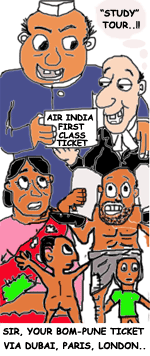
It reported that Balakrishnan, soon after taking over as Chief Justice, was bitten by the travel bug. He made at least seven trips abroad in 2007 traveling First Class with his wife with the air fare alone costing over a whopping Rs 39 lakh.
Apparently, during his 11-day trip to Pretoria, South Africa in August 2007, the Chief Justice took the following route – Delhi, Dubai, Johannesburg, Nelspruit, Capetown, Johannesburg, Victoria Falls, where the judge finally didn’t go and returned via Dubai to Delhi.
The air fare alone cost Rs 5.70 lakh and did not include the stay, TA, DA or Entertainment Allowance. Entertainment Allowance itself was over Rs 80,000.
Predictably, Union Law Minister HR Bhardwaj reacted in a belligerent fashion “They also need comfort; they also need to go out. Why they should be deprived of it.” He was also sympathetic of the judges’ need to be accompanied by wives though government rules that say judges cannot be accompanied by wives on work tours. “How can you deprive the wife? You are a woman. You should understand,” Bhardwaj is reported as having lashed out at the CNN-IBN correspondent.


 Our Constitution provides for an independent and efficient justice delivery system. No doubt there are delays in disposing the tax matters. On analysing the causes for delay one will find that delay is not because of courts but it is due to tax administration. In tax matters 70% of appeals are by tax department.
 The judgement of the Delhi Bench of the Tribunal in
  1. The State Commission, Delhi, by its order dated 10-3-2006 in Appeal No. 1815 of 2000 held that the services rendered by the Lawyer would not come within the ambit of Section 2(1)(o) of the Consumer Protection Act, 1986, as the client executes the power of attorney authorizing the Counsel to do certain acts on his behalf and there is no term of contract as to the liability of the lawyer in case he fails to do any such act. The State Commission further observed that it is a unilateral contract executed by the client giving authority to the lawyer to appear and represent the matter on his behalf without any specific assurance or undertaking.
 There is a popular commercial by a furniture maker running on television which uses a courtroom as the setting to demonstrate the long-lasting abilities of its plywood. Two young lawyers are arguing a matter about a buffalo which apparently caused damages to the Plaintiff, prompting him to seek damages from the owner of the buffalo. The Respondent’s demand is that the buffalo, being the alleged culprit, must be produced in court as a witness, leading to an uproar in the court and prompting the judge to adjourn the matter. Months turn to years and decades go by and the lawyers and the judge, now sprightly octogenarians, are still at the same stage at which they were at the beginning of the case. The plywood table stands mute spectator to the going-ons in the court room with the voice-over saying tongue-in-cheek “Chalta Rahe, Chalta Rahe” (It goes on and on).